
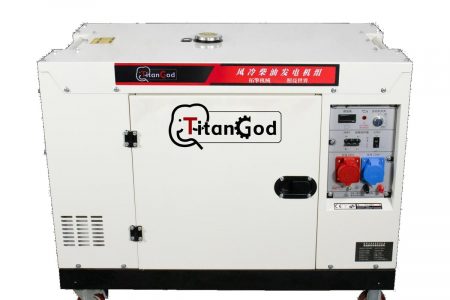
 Silent Type
T8800T 6 kW Silent Container Diesel Generator
6 kW ≈ 7.5 kVA 230
Model T8800T · 192FE engine · 72 dB(A) at 7 m · continuous running
Competitive export price · reply within 24 hours
View Details
A load bank test is easy to run badly. Connect the cables, switch on the steps, watch the kW climb, write the number down, disconnect — that is what a bad one looks like, and it will pass a set that is about to fail on site. This is the sequence that actually proves something, with the checks that separate a real test from a formality.
De-energise the generator output, lock off, and prove the conductors are dead with a tested instrument. Connect the bank. Ground the bank enclosure. Re-check the voltage tap selector matches the generator output before energising.
Run the set at no load for five to ten minutes. Oil pressure should reach normal, coolant should start circulating, and the exhaust should clear. Record idle frequency and voltage — an abnormal baseline tells you the test will be meaningless before you spend fuel on it.
First step only. Hold for 10–15 minutes. This is where cooling system faults and fuel starvation show up early, at low cost. Watch coolant temperature climb rate rather than absolute value: a fast climb at 25% means it will overheat at 75%.
Hold each step 15–30 minutes, long enough for temperatures to stabilise. Record at each step: kW, kVA, voltage per phase, frequency, coolant temperature, oil pressure, exhaust gas temperature if instrumented, fuel consumption rate.
Duration depends on the standard you are testing to. NFPA 110’s annual test profile for emergency systems is 30 minutes at 50% followed by 60 minutes at 75%. Commissioning and acceptance tests are usually longer and hotter: hold 100% until coolant, oil and exhaust temperatures plateau, typically one to four hours for a large set.
During the hold, watch for: frequency droop beyond the governor’s stated band, voltage instability, coolant approaching the alarm threshold, unusual exhaust colour, fuel pressure falling.
Unload in reverse steps, pausing briefly at each. Dropping 100% load in one step stresses the alternator and can trip protection. After the last step, run unloaded for five minutes to let the turbocharger and exhaust cool before shutdown — a hot shutdown cokes the turbo bearings.
The test is only useful if the numbers are comparable to the last one. Record against the same load steps each time. A set that held 98% of rated voltage at 100% load last year and holds 94% this year has an alternator problem developing, even though both tests “passed”.
NFPA 110 is the US standard for emergency and standby power systems, and its testing requirements are widely referenced well beyond North America because they are concrete:
Note that the annual profile tops out at 75%, not 100%. That is deliberate: 75% is enough to clear wet stacking and prove the fuel and cooling systems without the extra thermal stress. If your acceptance document demands 100%, that is a commissioning requirement, not an NFPA 110 one — do not confuse the two.
| Failure | How it shows up |
|---|---|
| Fuel starvation under load | Frequency sags as load increases; recovery slow. Often a blocked filter or an undersized supply line that only shows at high flow. |
| Cooling insufficiency | Coolant temperature climbs steadily and does not plateau. Radiator undersized, fan reversed, or air recirculating in the room. |
| Alternator / excitation fault | Voltage drops disproportionately as load rises, or oscillates. Only reliably caught under load — a no-load voltage check will look perfect. |
| Wet stacking already present | Black smoke at the start of the test that clears as load comes on. The set has been running too light for too long. |
For a standby set that only ever runs on test, annual load bank testing plus monthly 30% exercise is the accepted minimum. For rental fleets, test on every return from hire if the set has run above 50% for extended periods, and at least quarterly otherwise. For prime power sets running continuously at moderate load, the risk is not underloading but cumulative wear — test annually and trend the results.
Silent Type
Model T8800T · 192FE engine · 72 dB(A) at 7 m · continuous running
Silent Type
Model T11000T · 1100FE engine · 72 dB(A) at 7 m · continuous running
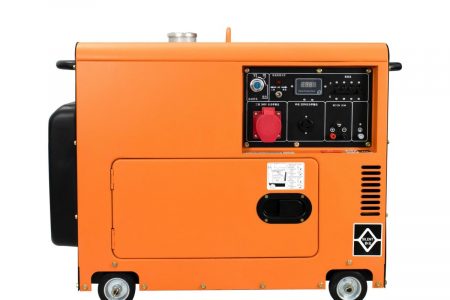 Silent Type
Model 10000T · 192F engine · 72 dB(A) at 7 m · continuous running
Send us your equipment list and site conditions, we will recommend a model.