
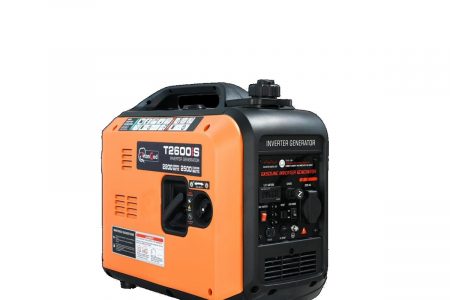
 Gasoline Silent
T2600iS 2.2 kW Inverter Silent Petrol Generator
2.2 kW ≈ 2.2 kVA 230 V
Model T2600iS · engine · 65 dB(A) at 7 m · 9 h at 50% load continuous running
Competitive export price · reply within 24 hours
View Details
Every sizing method reduces to the same formula, and every real project breaks it in a different way. Three worked examples show where the formula holds and where it needs adjusting.
Required bank kW = generator kW × target load percentage ÷ voltage derating factor
Generator kW comes from the nameplate: if it is given in kVA, multiply by power factor. The target percentage is a decision — 80% for standby maintenance, 100% for commissioning and prime power. The derating factor is (site voltage ÷ bank rated voltage)², and skipping it is the most common error in the chain.
Given: 500 kVA standby generator, 0.8 PF, 400 V site, annual NFPA 110 profile (50% then 75%).
Why 400 and not 300: 300 kW is a standard size, but it leaves zero headroom. If the site voltage runs at 380 V rather than 400 V, the derating factor becomes 0.903 and the bank delivers only 271 kW — below the 300 kW target. One size up absorbs normal voltage variation and gives room to run a 100% test later.
Specify: 400 kW resistive, 400 V, portable, 25 kW steps.
Given: a 625 kVA rental set, 0.8 PF, sent to a 380 V site in West Africa. The company already owns a 1,000 kW bank rated at 480 V and wants to know if it is enough.
But note what happens to the safety margin: the bank is running at 500 ÷ 627 = 80% of what it can actually deliver at that voltage. That is fine for a resistive bank but worth knowing, because the bank’s control panel will show 500 kW while the operator thinks he is only using half of a 1,000 kW unit.
The trap in this example: if the same 1,000 kW 480 V bank were used on a 240 V site, derating would be (240/480)² = 0.25, delivering only 250 kW — half of what the 500 kW generator needs. Voltage mismatch of this size cannot be engineered around; it needs a different bank.
Given: 2,500 kVA prime-rated set, 0.8 PF, 400 V, commissioning requires 100% load at 0.8 PF lagging.
The specification is therefore: combined resistive-reactive bank, 2,000 kW resistive + 1,500 kVAR inductive, 400 V, containerised.
Why a resistive bank alone will be rejected here: a 2,000 kW resistive bank can pull 2,000 kW at unity power factor — it can load the engine fully. But it cannot prove that the alternator holds voltage while supplying 1,500 kVAR, which is exactly what the data centre’s UPS and cooling load will demand. The commissioning engineer will read “resistive” on the test certificate and reject it.
Practical note: combined banks at this size are containerised, typically ISO 20 ft or 40 ft, and weigh tens of tonnes. Shipping and site positioning need planning at the order stage, not the delivery stage.
| Number | Where it comes from | What it changes |
|---|---|---|
| Generator kW | Nameplate kVA × PF | Sets the whole calculation. A 0.9 PF set is 12% more kW than a 0.8 PF set of the same kVA. |
| Target test percentage | The test standard, not preference | 75% vs 100% is a 33% difference in bank size and price. |
| Voltage derating factor | (site V ÷ bank V)² | Can swing the required rating by 60% in either direction — the largest single lever. |
Get those seven right and the sizing arithmetic is trivial. Get the voltage wrong and nothing else saves the project.
Gasoline Silent
Model T2600iS · engine · 65 dB(A) at 7 m · 9 h at 50% load continuous running
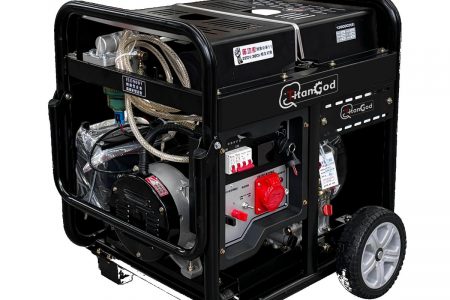 Open Frame
Model 6500 · 188F engine · · continuous running
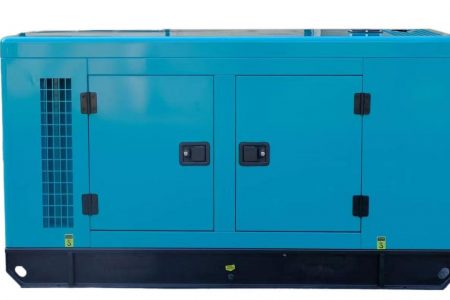 Gasoline Silent
Model T-20P-P · 470Q engine · 72 dB(A) at 7 m · continuous running
Send us your equipment list and site conditions, we will recommend a model.