
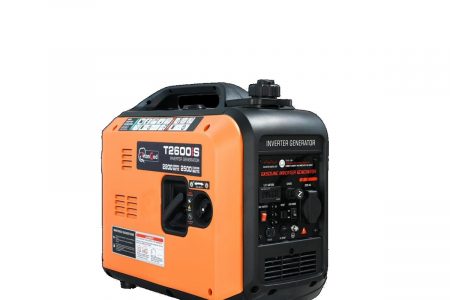
 Gasoline Silent
T2600iS 2.2 kW Inverter Silent Petrol Generator
2.2 kW ≈ 2.2 kVA 230 V
Model T2600iS · engine · 65 dB(A) at 7 m · 9 h at 50% load continuous running
Competitive export price · reply within 24 hours
View Details
This is the single most common load bank purchasing error, and it is invisible until the acceptance test fails. A generator is quoted in kVA. A load bank is quoted in kW. They are not the same number, and the gap between them is exactly the power factor.
A generator’s alternator is limited by current and voltage, which together give apparent power in kVA. How much of that apparent power can do useful work depends on the load: resistive loads use all of it, motors use only part and return the rest.
A load bank’s resistors dissipate real power only, so banks are rated in kW. There is no kVA rating on a resistive bank worth quoting, because at unity power factor kW and kVA happen to be equal — which is precisely why the confusion survives.
kW = kVA × PF
A 625 kVA standby generator at 0.8 PF produces 500 kW. If you order a “625 kW load bank” you have bought a unit 25% larger than you need, and it will be physically bigger, heavier and more expensive than necessary. If you order a 500 kVA bank, thinking the numbers line up, you may have bought something that cannot load the set to 100% — because a 500 kVA resistive bank is 500 kW only if it was quoted that way.
| Generator nameplate | Real power at 0.8 PF | Resistive bank needed for 100% test |
|---|---|---|
| 125 kVA | 100 kW | 100 kW |
| 250 kVA | 200 kW | 200 kW |
| 625 kVA | 500 kW | 500 kW |
| 1,250 kVA | 1,000 kW | 1,000 kW |
| 2,500 kVA | 2,000 kW | 2,000 kW |
The buyer reads “625 kVA” off the generator plate and orders a 625 kW bank. It works — the test can be done — but he has paid for 25% more resistor, more contactor, a bigger enclosure and more freight. On a 1000 kW unit that is several thousand dollars of dead capability that will never be switched in.
Worse. Some suppliers quote banks in kVA to make the number look bigger. A “500 kVA” resistive bank is 500 kW — but a “500 kVA” combined bank at 0.8 PF is only 400 kW of real power. The test then tops out at 80% and the commissioning engineer rejects it.
If the acceptance test says 100% load at 0.8 PF, you need the bank to deliver the kW at that PF, which means a combined bank with enough kVAR. Sizing purely on kW and ignoring the reactive part fails the same test in a different way.
Step 5 is the one that turns a correctly sized bank into an undersized one on site, and it deserves its own explanation — there is a full article on voltage derating linked below.
Most standby alternators are rated 0.8 PF. Some prime power and marine sets are rated 0.9 or 1.0. If yours is 0.9, a 625 kVA set is 562 kW, not 500 — and a 500 kW bank will only reach 89% of rated load. Read the plate, do not assume.
If you cannot find the PF on the nameplate, it is usually in the alternator datasheet rather than the generator set datasheet, because it is an alternator property. Ask for it rather than guessing: a wrong assumption here is the difference between a passing and a failing test.
Whatever you calculate, verify it against this: the resistive bank’s kW rating should be within 10% of the generator’s kW rating for a full-load test. If your answer is more than 10% off in either direction, you have almost certainly mixed up kVA and kW somewhere in the chain.
Gasoline Silent
Model T2600iS · engine · 65 dB(A) at 7 m · 9 h at 50% load continuous running
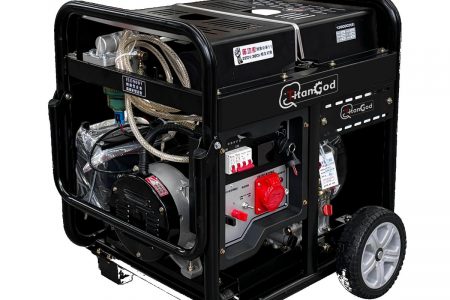 Open Frame
Model 6500 · 188F engine · · continuous running
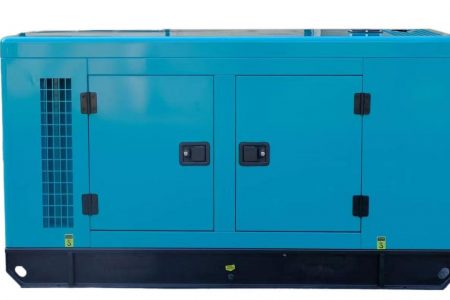 Gasoline Silent
Model T-20P-P · 470Q engine · 72 dB(A) at 7 m · continuous running
Send us your equipment list and site conditions, we will recommend a model.